
Free Cavity Wall Insulation Grants
If you receive a qualifying benefit, Free Cavity Wall Insulation grants are available to pay for the entire cost of having Cavity Wall Insulation professionally installed. The property must also be privately owned or rented and occupied at the time of survey.
If you are not entitled to a Free Cavity Wall Insulation grant, we can still arrange a survey and quote from an approved Installer. Costs are typically in the region of £500 to £600.
The grant funding is part of a scheme known as the Energy Companies Obligation (ECO). ECO4 is the current Government-backed energy efficiency scheme, regulated by Ofgem, and will run until 2026. The purpose of the scheme is to improve the energy efficiency of homes which have an EPC rating of D, E, F or G. The grants come from the main energy suppliers and they do not have to be re-paid.
With energy costs continuing to rise, Cavity Wall Insulation is one of the best ways to reduce your heating bills. Uninsulated Cavity Walls can cause up to 35% of the heat in a property to escape. Cavity Insulation typically saves a household up to £145 each year.
Click here if you are not sure whether you have Cavity Walls or if they are already insulated.
How It Works
Warning: Illegal string offset 'url' in /home/www/freeinsulation.co.uk/wp-content/themes/energy-link/parts/icons.php on line 23
Notice: Uninitialized string offset: 0 in /home/www/freeinsulation.co.uk/wp-content/themes/energy-link/parts/icons.php on line 23
-
Complete Online Form
-
Free Survey Booked
-
Insulation Installed
-
Grant Claimed
Notice: Undefined index: link in /home/www/freeinsulation.co.uk/wp-content/themes/energy-link/parts/icons.php on line 40
Notice: Undefined index: link in /home/www/freeinsulation.co.uk/wp-content/themes/energy-link/parts/icons.php on line 40
Notice: Undefined index: link in /home/www/freeinsulation.co.uk/wp-content/themes/energy-link/parts/icons.php on line 40
Notice: Undefined index: link in /home/www/freeinsulation.co.uk/wp-content/themes/energy-link/parts/icons.php on line 40
Who Qualifies For Cavity Wall Insulation Grants?
FREE Cavity Wall Insulation is available if someone in your home receives one of the following benefits:
- Child Tax Credit
- Housing Benefit (not the single person’s 25% Council Tax reduction)
- Income-Based Jobseekers Allowance
- Income-Related Employment Support Allowance
- Income Support
- Pension Credit Savings Credit
- Pension Guarantee Credit
- Universal Credit
- Working Tax Credit
- Child Benefit *
* Combined annual household income limits apply. Visit our who qualifies page for full details.
Not in receipt of a qualifying benefit? You may be eligible for a grant if your annual household income is £31,000 or less.
The other main criteria is that you own your property or rent it from a private landlord. We cannot assist Council or Housing Association tenants unless you are a Housing Association tenant who owns 50% or more of the property.
The property must also be occupied i.e. not empty or undergoing refurbishment. The wall area to be insulated must be at least 60% of the property size so extensions do not normally qualify for a grant. However, we can arrange a free survey and quote in this instance.
What Is Cavity Wall Insulation?
Most properties built of brick between 1924 and 1982 are likely to have a cavity between two layers of brick, or between brick and block, that was not filled with insulation when the property was built.
After 1982, Building Regulations changed and required insulation to be fitted in the Cavity at the time of build. Before 1924, properties were generally built without a cavity (known as solid wall properties).
A number of properties built after 1982 did not have Cavity Insulation fitted and we are able to help with a grant in most areas, providing it was built before 2005.
Most Installers use Cavity Insulation either made from shredded mineral wool (glass fibre) or polystyrene beads, that can reduce the amount of heat escaping from the walls by up to 35%.
Cavity Wall Insulation can save you up to £145 per year on energy bills and reduce carbon emissions by up to 610kg.
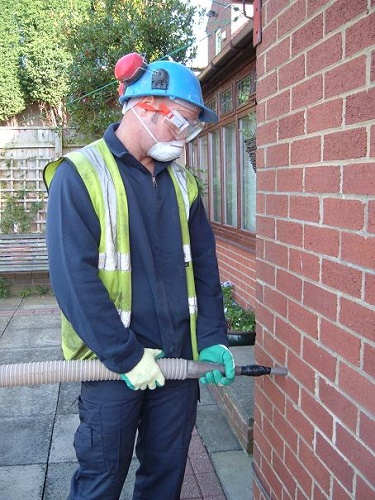
See if you qualify:
Click HERE to Find Out >>Is My Property Suitable For Cavity Wall Insulation?
Recent research, carried out by the Department of Energy and Climate Change (DECC), showed that only 58% of all properties that can benefit from Cavity Wall Insulation have been insulated. Your property could be among the remaining 42% still to be insulated.
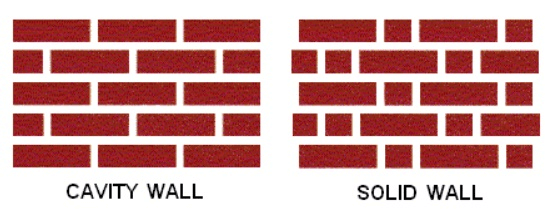
The first thing to check before applying for a Grant is whether your home has cavity walls. Most properties built of brick from 1924 onwards are likely to have a cavity. If your property was built before 1924, it is likely to have solid walls as shown below:
If you think that your property already has Cavity Wall Insulation, it is not worth applying for a Grant as Cavity Wall Insulation cannot be topped up.
You will NOT be able to have Cavity Wall Insulation installed if:
- Your property was built before 1924 or after 2005.
- The walls have already been filled with insulation.
- You live in a flat and do not have the agreement of neighbours above and below.
- There are any signs of damp on the inside or outside of the walls.
- The property is timber/steel framed, concrete or stone.
- Ventilation is inadequate and a vent cannot be fitted.
able to claim a grant for External Wall Insulation or Internal Wall Insulation.
Cavity Wall Insulation FAQs
How long does it take to install Cavity Wall Insulation?
An averaged size property will take around two to three hours.
Will I receive a guarantee?
Yes. The Installer will apply for a 25 year guarantee through one of three organisations: CIGA, Kinnell or GDGC.
How can I tell if my walls are already filled with Cavity Wall Insulation?
If you look closely, especially under the windows, you may be able to see where holes have been drilled and filled with cement. The holes are drilled where the mortar forms a T joint.
Can I get Cavity Wall Insulation if I live in a flat?
The Insulation must be installed from the ground floor to the roof. Each property is assessed individually for the grant, so you must have the consent of any neighbours above and below before you make an application.
What if I have damp in my walls?
You will need to have the problem checked and repaired before applying for Cavity Wall Insulation through EnergyLink. A local builder may be able to help you to assess this.
Are there any health risks from Cavity Wall Insulation?
No. The Insulation is sealed within the walls. If glass fibre is used, this is derived from sand which fits in with the natural brick and mortar fabric of the property.
Where can I find more information?
Visit the CIGA website to find out more about Cavity Wall Insulation: www.ciga.co.uk.
How Much Can Cavity Wall Insulation Save?
Warning: Illegal string offset 'url' in /home/www/freeinsulation.co.uk/wp-content/themes/energy-link/parts/boxes.php on line 38
Notice: Uninitialized string offset: 0 in /home/www/freeinsulation.co.uk/wp-content/themes/energy-link/parts/boxes.php on line 38
Cavity Wall Insulation prevents up to 35% of the heat generated in your home from escaping. This results in lower energy bills because your heating can be turned on less often, at a lower temperature and for shorter periods. Savings of up to £145 per year are possible.
Because less fossil fuel is being burned, Cavity Wall Insulation will also reduce carbon emissions by up to 610kg per year, therefore helping to protect the environment from climate change.
Savings figures are based on Energy Saving Trust estimates for a semi-detached property heated by gas.
How can EnergyLink help?
Warning: Illegal string offset 'url' in /home/www/freeinsulation.co.uk/wp-content/themes/energy-link/parts/boxes.php on line 60
Notice: Uninitialized string offset: 0 in /home/www/freeinsulation.co.uk/wp-content/themes/energy-link/parts/boxes.php on line 60
Our online form will make sure an approved Installer operates in your area, check that your property is likely to be suitable and give you an indication of whether you are likely to qualify for a Cavity Wall Insulation Grant. You can then enter your details and an approved Installer / Surveyor will contact you to book a no-obligation survey.
If you are happy to proceed, the Installer will arrange the work. Once the Cavity Wall Insulation is fitted, if you are entitled to a grant, our Installer will claim the Grant amount from an Energy Company or one of their agents. They will then apply for the 25 year Cavity Guarantee through CIGA, Kinnell or GDGC.